SOAP-based services currently dominate the enterprise landscape. Main reasons this are:
SOAP, however, is far from perfect. It adds complexity and overhead and makes implementation of message intermediaries (e.g., gateway products) more difficult (XML message has to be parsed in order to obtain any information about the message, such as an operation name). On the other hand, the uptake of WS-* standards has been very slow, perhaps with the exception of WS-Security, so the benefit of WS-* integration with SOAP failed to materialize. Another supposed SOAP benefit is the protocol neutrality, i.e., a SOAP message looks the same over HTTP, JMS, RMI or any other supported protocol. However, most services are implemented using HTTP, or in some cases, JMS without any headers (unless WS-* is used), so this benefit has limited value.
So it is fair to say that in many instances, SOAP itself does not add any value to Web services implementation. Nevertheless, it's continued to be used because of the reasons listed above. But this situation might be changing in the future.
WSDL 2.0 fully supports HTTP binding. WSDL 2.0 stirred a lot of controversy (I personally think that it's a step forward from WSDL 1), however, it was finally accepted as a W3C recommendation in June, so we can fully expect that vendors support will follow.
Additionally, JAX-RS specification was created and included into Java EE 6. This will also promote development of RESTful services behind the firewall.
Currently, there a preconceived notion that REST is only good for Internet/WEB 2.0 environment, whereas enterprise services should all be using SOAP. The emergence of the two new standards will help change this notion.
Ideally, developers should be able to use the simplest binding that gets the job done. HTTP/REST can be a good choice for many "query-style" services. Services that accept more complex data can use "Plain Old XML" over HTTP post. Finally, services that have to rely on WS-* specifications will utilize SOAP. In all these cases, developers should be able to use same set of APIs for invoking the service and same set of annotations (obviously, with different parameters) for creating the service.
Perhaps this is how Web service development will be done in the future, but we are certainly not there yet.
A Web services registry is arguably one of the most important components of SOA. The registry provides a single source of information about all services in an enterprise.
There are a number of commercial registry/repository products but all of them are quite pricey. Also, smaller organizations or organizations just starting with SOA may not need the full power of a commercial registry/repository product; most of it functionality will remain unutilized. On the other hand, existing registries do not do a particularly good job of managing dependencies between services as well as between service consumers and service providers. Dependency management must be a key consideration in SOA since, unlike in the case of monolithic applications, an SOA consists of a large number of “moving parts”, that is, services. In a well developed SOA most services depend on other services and these services in turn may rely on some other services. Being able to manage and analyze services dependencies is required in order to be able to implement robust and maintainable SOA.
Open source Maven project has become something close to a de-facto standard in the area of dependency management for building Java-based projects and components. (more...)
Several SOA vendors are trying to put together comprehensive suites of SOA products that in theory should be capable of addressing all aspects of SOA, including governance, integration, business process management and others.
Formation of SOA suites is having a tremendous impacts on how SOA products are selected as many organizations are being tempted to settle for "one stop shop" approach as opposed to doing proper product evaluation within each SOA product category. (Interesting discussion about SOA suites is available at ZDNet).
So what is a SOA suite and how offerings from different vendors support different aspects of SOA? The table below attempts to answer this question. (more...)
Developers working with REST and XML/HTTP services have traditionally used light-weight APIs, such as java.net classes or Apache HttpClient. Web services APIs provided by JAX-RPC were SOAP and "enterprise" only and they required J2EE libraries. The situation changed with the release of JAX-WS and its inclusion into Java SE 6. JAX-WS supports RESTful services; also, its Dispatch interface allows clients to work with XML directly as opposed to having to use object mapping or completely unwieldy SAAJ API. A nice example of using JAX-WS to implement a client for a RESTful service is available in Mark Hadley's blog.
However, I don't think that JAX-WS is going to become the primary way of implementing RESTful clients just yet. In many situations, HttpClient provides more flexibility and control over HTTP calls.
For example, it is very straightforward to turn on basic authentication for a client using HttpClient APIs: (more...)
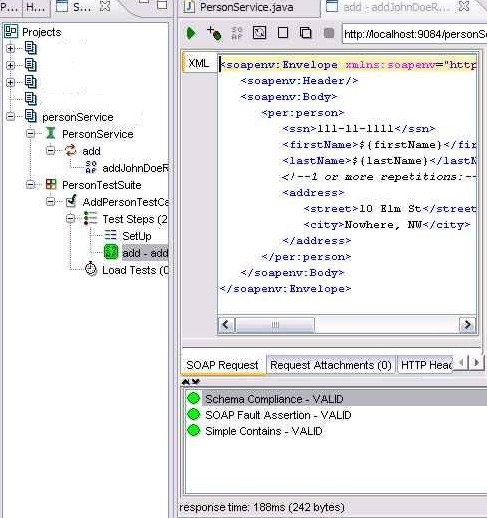
Open source soapUI tool has a number of benefits over developing test cases in Java using JUnit framework. Some of these benefits include:
Overall, soapUI allows developers and testers to create tests quicker and also makes tests easier to manage and update.
However, one needs to understand shortcomings of this approach. soapUI uses its own Web services client. The way it creates test messages is different from how regular (JAX-WS-based and other) Web services clients work. soapUI completely skips the step of generating Java classes from WSDL. It does not have to deal with XML marshalling/unmarshalling from/to Java objects. As a result, you are not invoking your service the way it will be invoked by real Web service consumers.
Technically, it may not be an issue in a majority of cases. The fact that soapUI is able to parse your WSDL/schema and generate test message means that you have a valid WSDL that should also be consumable by other technologies. However, it is possible that your WSDL/ schema may lead to sub-optimal (albeit perfectly valid) generated classes. For example, the schema that defines <addresses><address>...</address>...</addresses> XML will result in JAXB compiler generating Addresses class that returns the list of type Address. This may or may not be how you want Java classes to look like for the clients. Perhaps you may want to consider to get rid of <addresses> so that no extra class is generated.
In other words, using soapUI (or similar UI-based Web services testing tools, such as SOAPScope) does not allow you to understand all the details of how your Web service will be consumed in the real world.
Another advantage of JUnit test cases is that they can be used as examples illustrating the use of your service. The test classes can be published along with other Web service documentation or handed over to consumers to help them jump-start their client implementations. Unfortunately, soapUI test cases can't be used for this purpose.
The shortcomings of visual testing tools such as soapUI can be addressed by complementing soapUI tests with JUnit tests. I usually start with soapUI since it is so easy to get up and running with it. Once soapUI test is implemented, I go back to Java, generate Web services client classes from WSDL and implement a JUnit test class. The logic that goes into a JUnit test class obviously depends upon a Web service. But at the very least, there should be one JUnit test per service that invokes the service using generated classes and libraries provided by your Web service product of choice. This way, we can see exactly how our services will be consumed by our clients.
This is a brief tutorial describing how to create a Web service using WSDL and annotations.
The approach presented here allows you to design and implement your WSDL/Schema and Java classes
independently without having to generate anything. You can then use annotations
to map Java classes to appropriate WSDL and Schema elements.
Since JAXB and JAX-WS have sensible defaults, the number of annotations can be kept
to the minimum.
In my opinion, it is always best to develop WSDL and schemas by hand to ensure that the service contract is appropriately defined and also that the schema can be re-used (by other services) and extended if necessary. I do not recommend using annotations for automatically producing WSDL and schemas at runtime as this leads to simplistic schemas and WSDLs.
Generating classes from WSDL/schema sometimes makes sense, say in situations when you have to use a pre-defined schema. However, as with any code generation, it creates a maitainance problem especially if there is a need to put behavior into generated classes. So it is desirable to be able to evolve object model and service implementation classes independently from WSDL/schemas. You can do it quite easily by following the steps below.
Even though I use the word "create" when describing some of the steps, the same approach will also work for updates or refactoring caused by changes in service requirements.
The steps are the following:
public String add( Person person )
xsd:token instead of xsd:string since "token" does not allow
carriage return, tabs, and leading spaces:
<xsd:element name="person">
<xsd:complexType >
<xsd:sequence>
<xsd:element name="ssn" type="xsd:token"
minOccurs="1" maxOccurs="1"/>
<xsd:element name="firstName" type="xsd:token"
minOccurs="1" maxOccurs="1"/>
<xsd:element name="lastName" type="xsd:token"
minOccurs="1" maxOccurs="1" />
<xsd:element name="address" type="Address"
minOccurs="1" maxOccurs="unbounded"/>
</xsd:sequence>
</xsd:complexType>
</xsd:element>
<wsdl:definitions
targetNamespace="http://personservice"
xmlns="http://personservice"
xmlns:pers="http://person"
xmlns:soapenc="http://schemas.xmlsoap.org/soap/encoding/"
xmlns:wsdl="http://schemas.xmlsoap.org/wsdl/"
xmlns:wsdlsoap="http://schemas.xmlsoap.org/wsdl/soap/"
xmlns:xsd="http://www.w3.org/2001/XMLSchema">
<wsdl:types>
<xsd:import namespace="http://person"
schemaLocation="person.xsd" />
<!-- Return value -->
<xsd:element name="status" type="xsd:string" />
</wsdl:types>
...
// By default JAXB uses getters/setters for marshaling/unmarshaling
// Using fields access allows us not to define getters/setters for
// all mapped instance variables.
@XmlAccessorType(XmlAccessType.FIELD)
// We need to provide the namespace, otherwise it defaults to
// the package name
@XmlRootElement(namespace="http://person")
public class Person {
// we only need annotations for variables that don't match
// element names
private String ssn;
private String firstName;
private String lastName;
@XmlElement(name = "address")
protected List<Address> addresses;
...
@XmlRegistry
public class ObjectFactory {
public Person createPerson() {
return new Person();
}
public Address createAddress() {
return new Address();
}
}
@WebService(
// all values must match corresponding attributes
// and elements of the WSDL file
// Name of the port type in WSDL
name="PersonService",
// Target namespace of WSDL, could be
// different from the schema namespace
targetNamespace="http://personservice",
serviceName="PersonServicePorts",
portName="PersonService",
// the file must be available to Web container
wsdlLocation="WEB-INF/wsdl/PersonService.wsdl"
)
/*
* We'are using "bare" style since "add" operation
* takes only one argument, person document. Therefore, there
* is no need to "wrap" it by nesting it inside operation element.
* Note that "wrapped" style is the default.
*/
@SOAPBinding(parameterStyle=SOAPBinding.ParameterStyle.BARE)
public class PersonService {
@WebResult(name = "status")
public String add( Person person ) {
System.out.println("Adding person :"+person );
return "Added "+person.getFullName();
}
}
SoapUI Project (you can import it into SoapUI).
You can also download all files in a zip file.
The final version of Basic Security Profile 1.0 (BSP) was recently been released by WS-I. This is certainly a welcome event; WS-Security is broad and complex and it has been plagued by interoperability issues for quite some time (although the situation has improved in the last year or so). The BSP document seems to have pretty good level of details with plenty of good examples that are easy to follow.
I looked at a few messages generated by Axis used in conjunction with Apache WS-Security implementation called Rampart and at the first glance they seem to be compliant with BSP, although all my examples use WS-Security username token profile, which is the simplest form of passing credentials with WS-Security.
As an example, Rampart generates the correct form of the password tag, which includes "type" attribute (this attribute is not mandated by WS-Security, however, it is required by BSB):
<wsse:Password
Type="http://docs.oasis-open.org/wss/2004/01/oasis-200401-wss-username-token-profile-1.0#PasswordDigest">
B5twk47KwSrjeg==
</wsse:Password>
BSP is going to make the use of WS-Security more widespread, although this is not going to happen overnight. Currently, none of the public Web services (Yahoo, Ebay, Amazon) use WS-Security, which is not surprising since the standard is not fully supported by such languages as PHP, Python and Ruby (although some aspects of WS-Security are supported in PHP). Even platforms for commercial services, such as StrikeIron, don't use it (StrikeIron does support WS-Security for communication between its broker and service providers, but not for client calls).
In any event, I'm pretty confident that we can count on rising WS-Security adoption in an enterprise.
Web service providers communicate with their customers (consumers) by the means of publishing WSLD of the service. In most cases, developers create the client code for the service by generating classes from the published WSDL file. While JAX-WS makes it possible to avoid code generation entirely (as I described in this post) and hand-code all client-side classes, in all but the most trivial cases using code generation is the easiest way to start developing a Web service client.
Service providers need to keep in mind that WSDL is the only "bridge" between providers and consumers. Service providers may have great clean code with nicely defined interfaces and object model; however, this code won't be shared with consumers (unless, perhaps, we are talking about an internal service used for integrating components of the same application, but even in this case developers should beware of created tight coupling). Therefore we need to make sure that WSDL that we publish will help service consumers generate good client-side code.
JAX-WS mandates the following mappings between WSDL and the generated client code:
wsdl:portType translates to the Java interface (business interface) of a Web service (where each operation maps to a method of the interface).
wsdl:service translates to, essentially, a factory class that extends javax.xml.ws.Service. This class has "get" methods for each port defined as part of the service element. "getPortName" methods return dynamic proxy that implements the service business interface.
Keeping these rules in mind, I use the following naming conventions to ensure that the generated code will contain classes with meaningful names:
The following example illustrates the approach:
JSON is a simple object serialization approach based on the JavaScript object initializers syntax. The code for initializer (object literal) is put into a string and then interpreted using JavaScript eval() function or JSON parser (which is very lightweight):
serializedObj='{firstName:"john", lastName:"doe"}';
...
// This is just an example, JSON parser should be used instead
// to avoid security vulnerabilities of "eval"
var obj = eval("(" + serializedObj + ")");
document.getElementById("firstName").innerHTML=person.firstName;
JSON is used extensively in various AJAX frameworks and toolkits to provide easy object serialization for remote calls. It is is supported by both GWT and DOJO. There is a growing realization that perhaps JSON should be considered as an option when implementing SOA, for example Dion Hinchcliffe recently published a blog entry suggesting that JSON (and other Web 2.0 technologies) must be seriously considered by SOA architects.
So what are the benefits of using JSON relative to XML (for this comparison I want to focus just on XML and stay away from SOAP)? Here is my brief take on that, there are also numerous other articles and posts on the subjects.
| JSON | XML |
|---|---|
| JSON strengths | |
| Fully automated way of de-serializing/serializing JavaScript objects, minimum to no coding | Developers have to write JavaScript code to serialize/de-serialize to/from XML |
| Very good support by all browsers | While XML parsers are built-in into all modern browsers, cross-browser XML parsing can be tricky, e.g., see this article |
| Concise format thanks to name/value pair -based approach | Verbose format because of tags and namespaces |
| Fast object de-serialization in JavaScript (based on anecdotal evidence ) | Slower de-serialization in JavaScript (based on anecdotal evidence ) |
| Supported by many AJAX toolkits and JavaScript libraries | Not very well supported by AJAX toolkits |
| Simple API (available for JavaScript and many other languages) | More complex APIs |
| JSON weaknesses | |
| No support for formal grammar definition, hence interface contracts are hard to communicate and enforce | XML Schema or DTD can be used to define grammars |
| No namespace support, hence poor extensibility | Good namespace support, many different extensibility options in Schema |
| Limited development tools support | Supported by wide array of development and other (e.g., transformation) tools |
| Narrow focus, used for RPC only, primarily with JavaScript clients (although one can argue that it's one of the strengths) | Broad focus - can be used for RPC, EDI, metadata, you name it |
| No support in Web services -related products (application servers, ESBs, etc), at least not yet | Supported by all Web services products |
So the bottom line is that JSON and XML are, of course, two very different technologies; XML is much broader in scope so I'm not even sure if comparing them side by side is fair.
As an object serialization technology for AJAX (or should it now be called AJAJ since we've replaced XML with JSON?) JSON looks very appealing. Anybody who ever tried parsing SOAP directly in a browser (while having to support multiple browsers) can attest that this is not a straightforward task. JSON simplifies this task dramatically. So I think that ESB vendors should definitely start thinking about adding JSON to the list of formats they support.
One of the keys to SOA success is that it should be easy to consume a service, i.e., the entry barrier for service consumers must be low to support "grass root" SOA adoption. While a top-down SOA effort may succeed, it will certainly take longer than bottom-up ("grass-root") approach when developers are able to consume services as they see fit. AJAX/JSON fits this bill perfectly - it is easily understood by developers and it does not require any Web services -specific tools or infrastructure.
So overall I'm pretty enthusiastic about JSON.
Web services repositories are almost always mentioned in conjunction with SOA governance as its key enabler and there is a widespread notion that a repository is a key component of an SOA.
To me there are two types of SOA governance. There is strategic governance which is part of the overall IT governance that deals primarily with funding and other "big" decisions ("big G"). There is also more "tactical" SOA governance which deals mostly with configuration management (CM) (e.g., release management) of individual Web services ("small g").
There is also Web service management, including SLA monitoring and enforcement, and, perhaps, security, but to me that's just an operational aspect of SOA governance and it's distinctly separate from big G (funding) and small g (configuration and change management).
So, having been in a developer's shoes for the most of my career, I'm primarily interested in "small g", I'm sure management types can figure out "Big G" much better than I am.
So how this "small g", or SOA CM, is different from CM that we've been doing routinely over the last, well, at least 20 years? Why all of a sudden we're told that we need new tools for that, such as Web services registries and repositories?
I thought that we already have a repository that we know very well, and this is our version control repository - CVS, SVN, ClearCase, Perforce, whatever. So all our code and code-related artifacts, including, of course, WSDL and schema files (and whatever WS-* files, such as WS-Policy, we'll need in the future) are already checked into our version control repository of choice. We can do a lot of good things with version control repositories, including all kinds of analysis, diffing, etc. We can develop ant or rake script to integrate build and deploy process with version control. With tools like Maven we can do pretty complicated dependency management. There are also continuous integration tools, build servers, change management tools, reporting tools and all kinds of other software helping us to deal with the code we're developing. In other words, we know how to "govern" our code and so "governing" a few extra XML files (WSDL, Schema) should not be that difficult or special.
So I just don't see how a Web services repository is going to make any of these tasks easier.
What we do need is better WSDL and Schema presentation and visualization tools, so that Web service consumers don't have to always deal with raw XML. But I doubt this task warrants an expensive SOA repository, and there are some tools out there that can do it on the cheap.
SOA repositories also provide some run-time APIs so that service consumers or intermediaries can dynamically discover the most suitable service. Quite frankly, I think this scenario is a little far-fetched, especially given the lack of support for dynamic discovery in existing WS tools and products. Then there is also support for dynamic endpoints a la UDDI (or directly using UDDI standard), but, again, dynamic endpoints can be supported much more easily using configuration files as opposed to heavy-weight run-time APIs. Extremely low acceptance of UDDI is the proof of that.
So perhaps SOA registries and repositories are useful for "Big G" governance tasks (although I have my doubts - e.g., how relevant are WSDL files for funding decisions?), but the "small g", that is, CM tasks, can certainly be more efficiently handled by existing CM tools. SOA repository vendors should think about extending existing CM tools instead of trying to create specialized environments just for Web services.
Good Web services interoperability is an absolute must for a successful SOA implementation, but why interoperability has been so difficult to achieve?
I think that inability to comply with a published Web services contract expressed via its WSDL/Schema could be one of the leading causes of interoperability problems (I use the term "interoperability" pretty broadly here).
For example:
My biggest pet peeve is that most JAX-RPC implementations today don't even support schema validation out of the box (hopefully this will change in JAX-WS). I understand that full validation against a schema could be expensive, but can we at least handle required parameters/fields as they defined in the schema? Types mismatch will certainly cause an error, why not a missing mandatory field?
Note that I'm not talking about WS-I profiles, .NET/Java interop, and differences in WS-* implementations. I've seen all of the above problems while working with different Web services implementations in Java (mostly JAX-RPC).
And it is not just about interoperability - reliance on subtle conventions as opposed to a published contract makes architectures more fragile and more tightly coupled.
So my advice is simple - write a handler (at lest for development/test environments) and enable schema validation on the server and, under some circumstances (i.e., you don't control the service), on the client. This will save you from many interoperability problems, guaranteed.
"Wrapper"/"non-wrapper" Web services styles are mandated by JAX-RPC and JAX-WS specifications and are explained in details in documentation or in other sources, for example in this article. However, from my experience, there is still a lot of confusion among developers about differences between these two styles and also how a particular style affects design and implementation of a Web service.
First of all, we need to understand that "wrapper"/"non-wrapper" style is a characteristic of a Web services implementation framework (such as JAX-WS), as opposed to a style defined in WSDL. In fact "wrapper"/"non-wrapper" can only be used in conjunction with the document/literal style defined in WSDL. "wrapper"/"non-wrapper" setting defines how Web service request/reply messages are interpreted by a Web service provider/consumer. Quite simply, "wrapper" style tells the Web service provider that the root element of the message (also called "wrapper element") represents the name of the operation and it is not part of the payload. This also means that children of the root element must map directly to parameters of the operation's signature. The "non-wrapper" style (also sometimes called "bare"), does not make this assumption; in this case the entire message will be passed to the service operation. The reply message is handled in a similar way.
"Wrapper" style can be used for the following method:
public String produceFullName(
// note we have to provide names in annotations
// to comply with the schema.
// otherwise generic "in0", "in1" names are used.
@WebParam(name = "firstName")String firstName,
@WebParam(name = "lastName") String lastName );
The request SOAP messages for this method will look like this:
<soap:Envelope
xmlns:soap="http://schemas.xmlsoap.org/soap/envelope/"
xmlns:xsd="http://www.w3.org/2001/XMLSchema"
xmlns:xsi="http://www.w3.org/2001/XMLSchema-instance">
<soap:Body>
<produceFullName xmlns="http://personservice">
<firstName>John</firstName>
<lastName>Doe</lastName>
</produceFullName>
</soap:Body>
</soap:Envelope>
However, suppose we implemented the same function differently:
public String produceFullName(
@WebParam(name = "person",
targetNamespace="http://person")
Person person );
This method can be used with "non-wrapper" style resulting in the following
request message:
<soap:Envelope
xmlns:soap="http://schemas.xmlsoap.org/soap/envelope/"
xmlns:xsd="http://www.w3.org/2001/XMLSchema"
xmlns:xsi="http://www.w3.org/2001/XMLSchema-instance">
<soap:Body>
<ns2:personExt xmlns:ns2="http://person">
<firstName>John</firstName>
<lastName>Doe</lastName>
</ns2:personExt>
</soap:Body>
</soap:Envelope>
In JAX-WS, "SOAPBinding" annotation can be used to specify the style, e.g.,
@SOAPBinding(parameterStyle=SOAPBinding.ParameterStyle.BARE).
Note that "wrapper" is the default. In JAX-RPC the "wrapper" style is
specified in the Web service mapping xml file by adding "wrapped-element"
element to the service endpoint mapping.
If you generate your Java artifacts from WSDL file, the "wsdl2java" tool will automatically assume "wrapper" if operation name matches the wrapper element name and if some other requirements are met (some "wsdl2java" implementations also allow to control "wrapper"/"non-wrapper" using a command-line option).
So once again, "wrapper"/"non-wrapper" is a data binding style used in the context of a particular Web service provider/consumer. It is not part of the contract of a Web service, since it is not mentioned anywhere in the WSDL file. In other words, if you are a Web service provider, your consumers don't have to know or care whether your implementation style is "wrapper" or "non-wrapper". They may very well choose the "non-wrapper" style for their client's implementation and this client should interoperate with your "wrapper" service without a hitch (at least in theory).
In fact, the "wrapper" style is supported widely but not universally. From what I understand, the support for the "wrapper" style first appeared in .NET and later on Java-based Web services frameworks began supporting it as well (in Axis and others). I think it is also supported by Perl SOAP library. However, this style may not be supported by other languages, for example, I believe that PHP 5 SOAP engine does not have a notion of the "wrapper" style.
"Wrapper" style is really an RPC-style binding over "document/literal" WSDL style. The basic premise of the "wrapper" style is that our service is a remote method that takes some parameters (as opposed to pure message-based paradigm of a "non-wrapper" Web service, where method name is not explicitly provided in the message). So how "wrapper" with "document/literal is better than "rpc/literal" WSDL style? Here are some of its advantages:
"Wrapper" style has one interesting drawback, which may not be immediately obvious. Most Web services engines (at least the ones that I had a chance to work with) use positional parameter binding with "wrapper" style. This means that if a service signature changed (e.g., a new parameter was added), clients will have to change as well. In other words, with "wrapper" style, all parameters have to be present in the XML message (although they can be defined as null using "xsd:nil" attribute). This is despite the fact that the element corresponding to the parameter can be defined as optional in the schema. "non-wrapper" style does not have this problem; adding a new optional element does not affect clients, since binding is always name-based. This creates somewhat tighter coupling between "wrapper" style consumers and providers. This may also violate the contract of the Web service defined by its schema. To get around the last problem, you may want to define all child elements of the wrapper root element as required (minOccurs=1); optional elements must be made nillable. For some reason JAX-WS spec does not explicitly state this.
JAX-WS, however, does impose some additional restrictions on the "wrapper" style, the most important one being that the wrapper element's content type must be "sequence". This makes sense, since we're trying to model a method's signature, which is always represented as an ordered list of arguments (at least in Java/C#).
As far as the "non-wrapper" style goes, probably the most obscure thing about it deals with how a SOAP engine decides which operation to invoke based on the message type (assuming a Web service has multiple operations), since operation name is not explicitly provided by the message (unless "SOAPAction" header is used, however, this header is HTTP-only and also optional in JAX-WS). With "non-wrapper", each operation must accept a message that corresponds to a unique XML element name. Note that it is not enough to define different WSDL messages using "wsdl:message" element, each message must be represented by a different element in the schema. Web service engines use unique element names to determine Java method names (that correspond to WSDL operations). This means that with "non-wrapper" you can't have different operation names processing the same message, e.g., process(Customer) and processDifferently(Customer) can only be implemented by creating different customer types.
So we have an interesting dilemma - "wrapper" does not support overloaded methods (in fact, I don't think WS-I allows them either), whereas "non-wrapper" does not support methods with the same signature (at least under certain conditions).
So how should we decide when to use the "wrapper" style? My approach is always the following:
HTTP or HTTPS can be viewed as the current de-facto standard transport binding for Web services. It is frequently said, however, that HTTP is inherently unreliable and not appropriate in situations where guaranteed delivery and other Quality of Service (QoS) characteristics are required. To deal with this issue, many Web services products, commercial and open-source, offer a non-standard (meaning that it is not part of a WS-I profile) transport binding using JMS or other messaging APIs. Alternatively, WS-ReliableMessaging (WS-RM) specification defines a reliable messaging protocol for Web services independently of the transport binding. Currently, WS-RM is supported by several Web services products.
It is tempting to standardize on one of these alternatives for an enterprise SOA implementation in order to meet QoS requirements. However, we need to realize that both of these options add complexity to Web services implementation and greatly impair interoperability. JMS binding requires that all Web service consumers must support a particular messaging provider. Additionally, appropriate messaging resources (queues, connection factories) must be configured on the server and, sometimes, on the client's side (e.g., MQ channels). A Web service provider has to be able to communicate with a messaging provider e.g., to consume a message from a queue (which calls for a Message Driven Bean in J2EE environment). So while these issues are not insurmountable, they certainly make things more complicated and, among other things, require full J2EE stack for Web services implementation.
WS-RM is currently being standardized by WS-I, there is also project "Tango" that specifically addresses interoperability between Sun and Microsoft implementations. Unfortunately, WS-RM support is still far from being uniformed among Web services vendors. Also, from what I understand, WS-RM by itself is not sufficient since it does not define how (or if) a WS-RM conversation participates in a transaction. So then WS-Transaction or some proprietary vendor extension is needed, and that in turn calls for the ability to support XA. I also suspect that the use of a persistent storage on the client is the only way to support all WS-RM requirements (e.g., what if the client goes down in the middle of a message exchange?), so this makes clients "fatter" and more complex.
The bottom line is that "good old" SOAP over HTTP is the easiest and the most interoperable way to implement Web services today. So how much can we trust SOAP/HTTP Web services and should HTTP even be considered in an enterprise setting where QoS is almost always a requirement?
First, we need to remember that HTTP as well as virtually any other communication protocol today (including IIOP and protocols used by messaging providers) is based on TCP. The whole purpose of TCP is to be able to transfer data reliable and so it employs acknowledgements and sliding window mechanism to guarantee the delivery of data. What does it mean in terms of Web services? Say, we have a one-way service. If we invoked a service and received a successful reply (no SOAP faults or HTTP errors), we can be confident that our SOAP message reached its destination. But what if the connection went down in the middle of the call and we received a timeout error? Our message exchange is now in an ambiguous state. If the message has not been received, we need to invoke the service again, but, on the other hand, if it has been received, the duplicate message may lead to an inconsistent state if the service provider is not able to handle duplicates correctly.
QoS provided by messaging systems or WS-RM helps us in this situation by ensuring that the message will only be delivered once; messaging systems can also handle re-delivery of messages and "store and forward" (there are other QoS policies besides "exactly once", but "exactly once" is the most stringent one). Messaging systems also provide another important benefit by allowing a Web services call to participate in an atomic transaction. This allows service consumers to keep in synch multiple resources (including the ones provided by Web services) thus improving data integrity and reliability.
So where does it leave SOAP/HTTP services? Based on the explanation above, SOAP/HTTP is not the best fit when:
However, we still might be able to use SOAP/HTTP if we make our service consumers a little smarter. Specifically, service consumers must be able to meet the following requirements:
As an example, let's take a look at "Create/Read/Update/Delete" (CRUD) operations. While real-life services oftentimes do much more than just "CRUD" (e.g., calculations), it is a valid simplification for our purposes.
| Operation | Is Indempotent? | Required Service Consumer Behavior |
|---|---|---|
| Create | No |
Must be able to retry the call
Must be able to handle "record already exists" error. |
| Read | Yes | None |
| Update | Yes, unless update involves calculating new values based on the existing values, e.g., incrementing a counter | Must be able to retry the call |
| Delete | No |
Must be able to retry the call
Must be able to handle "record does not exist" error. |
So what is the takeaway? SOAP/HTTP can be used in many (if not most) situations, however, implications of this decision must be fully understood. All service consumers must be made fully aware of these implications. Most importantly, service consumers must implement proper logic for handling connectivity failures and application errors. In some cases, users of service consuming application may need to be instructed about how to react to certain application errors.
Schema validation framework that I covered earlier is actually fully supported by JAXB. If you're using XFire, you will have to switch to JAXB binding in order to utilize it.
As described in XFire documentation, you can specify "schema" element as part of your service definition and point it to your schema. From what I understand, however, this does not enable validation, it just tells XFire to use your schema as part of the generated WSDL (in response to "?wsdl" requests). So I actually had to develop a simple handler to enable it:
public class JaxbValidationEnablingHandler extends AbstractHandler {
public JaxbValidationEnablingHandler() throws SAXException{
super();
setPhase(Phase.PARSE);
before(ReadHeadersHandler.class.getName());
}
public void invoke(MessageContext ctx) {
ctx.setProperty(JaxbType.ENABLE_VALIDATION, "true");
}
}
Another problem that I encountered was that validation exceptions don't reach the client, instead the client receives meaningless "Can't unmarshal" exception. A simple change in XFire's JaxbType class fixes that though.
So how does this approach compare to the validation handler approach that I presented in the previous post? On one hand, relying on JAXB allows us to easily handle both "wrapped" and "bare" Web service styles. It also requires minimal effort to implement. On the other hand, very often with Web services there is a need to be able to process XML without reading it into objects, so, chances are, JAXB won't be used in all cases. Also, non-JAXB approach provides for more sophisticated error handling using custom error handlers that can be used in conjunction with the validation framework.
Another requirement that have to be considered regardless of the approach is integration with various XML and Web service registries that are becoming wide spread in large organizations. This means the ability to read schema from a URL or even over UDDI or proprietary API.
Clearly, there is still some work to be done in order to make schema validation the norm for Web services.
JAX-RPC supports two major ways of developing Web services: "bottom-up", which allows to generate WSDL from a Java interface and "top-down", which generates Java classes from WSDL. Both of these approaches suffer from one major drawback. WSDL/Schema/mapping files or Java classes are fully re-created every time there is a need to change Web service interface and so it becomes a developer's responsibility to merge existing WSDL files or Java code with the generated files. The need to manually change WSDL/Schema stems from the fact that the generated files are usually very "basic", they do not take advantage of advanced schema capabilities, they don't use WSDL/Schema modularization and so on. Generated Java classes are even more problematic. You really don't want to have simple "value" classes without any behavior with fully exposed properties. And adding behavior requires manual intervention.
In reality, there is a way to evolve two sets of artifacts (WSLD and Java classes) independently without any generation by manually updating Java-WSDL mapping file. The format of this file, however, is the antithesis of the "convention over configuration" idea. The format is extremely verbose; each and every field has to be mapped explicitly and so manual modification of this file poses a real challenge for any more or less complex data structure.
The latest JEE Web service specification, JAX-WS, fixes this problem by heavily leveraging annotations. For data mapping, annotation support is provided by JAXB specification. JAX-WS and JAXB finally free developers from having to rely on the brittle code generation approach.
In fact, JAXB still supports code generation and so developers can use it for generating Java or WSDL files. The generated artifacts could provide a good starting point for a Web service interface. After that, however, it is pretty easy to keep both sets of artifacts in synch by updating annotations and/or WSDL/Schema files.
How does it work in practice? Let's say we have this very simple schema:
<element name="person">
<complexContent>
<sequence>
<element name="firstName" type="xsd:string" />
<element name="lastName" type="xsd:string"/>
</sequence>
</complexContent>
</element>
The following class will match the schema:
// By default JAXB uses getters/setters to drive marshaling/unmarshaling
// Using fields is easier, since they can be defined more compactly
// in one place and also moved around to manipulate order.
// Beware though - getters/setters are ignored in this case
@XmlAccessorType(XmlAccessType.FIELD)
// We need to provide the namespace, otherwise it defaults to
// the package name
@XmlRootElement(namespace="http://myarch.com/personservice")
public class Person {
// note that JAXB marshals instance variables in the order they
// declared
protected String firstName;
protected String lastName;
...
Note that JAXB provide several
additional attributes and annotations which I'm not using here - I'm trying to rely as much as
I can on "convention over configuration". Element names, for example, match my variable names,
so there is no need to provide annotations for individual fields (however, in this case,
you can't use qualified locals
in your schema since JAXB won't prefix nested elements.)
Many JAXB annotations, such as "XmlType" are only used for generating schema from Java classes. Same is also true for most attributes of XmlElement. Oftentimes developers specify "required" and "nillable" attributes of XmlElement annotation thinking that JAXB will automatically enforce these constraints, e.g. :
@XmlElement( required = true, nillable=false)
private String lastName;
However, these parameters are not used at
run-time. JAXB 2.0 actually relies on the
schema validation framework and so
these parameters can be omitted assuming that the schema contains the constraints.
In other words, we only have to use those annotations that help us to correctly marshal/unmarshal our objects.
The only other step that we need to take is to create ObjectFactory class in same
package with the mapped class. In this class we need to define a factory method for the root
element of our content tree (you don't need to worry about nested datatypes even
if they map to other classes). From what I understand, JAXB does not actually invoke any
factory methods, however, it does check for their presence in ObjectFactory.
The factory method looks simple enough:
public Person createPerson() {
return new Person();
}
Now we can make changes to our Java classes and the corresponding WSDL/Schema files without ever having to resort to code generation. In my mind, this is a preferred way. We can see from Object-Relation mapping that "pure" "top-down" and "bottom-up" don't really exist. How often do we generate DDL from Java classes or vice versa? Different data representations supported by different technologies have to be able to evolve independently without having to play by each other rules. JAXB helps us to achieve it pretty easily.